
Who Holds Hartford Arrest Records
Hartford County is a place, not a records agency. Connecticut shut down county government in 1960. Towns and cities became the local units that matter. Jail and prison functions moved to the state, under the Connecticut Department of Correction. So there is no county sheriff here. No sheriff roster, county jail, or county booking app exists. That single fact shapes every search. The arresting police department keeps its own arrest report. Connecticut State Police holds any arrest it made. DOC takes over custody records once a person enters the correctional system, and the Judicial Branch runs the court docket. Know the town, the agency, and the stage of the case before picking a database. The Connecticut State Library confirms counties survive only as geographic divisions.
Finding Hartford County Recent Arrests
Begin with municipal sources. Hartford Police posts a daily, paginated arrest report. New Britain Police publishes a seven-day Press Arrest Log. West Hartford Police offers selected press releases. It posts no complete daily arrest roster. For any other town, try that town's department or Connecticut State Police. No city feed captures every arrest across the county's geography. Move to the DOC locator next. Use it if the person may still be held. The Judicial Branch criminal lookup tracks arraignment, plea, dismissal, nolle, or sentence afterward. A nolle simply means the prosecutor declined to pursue the charge at that stage. For custody notifications about one person, see the VINELink Check.
- Identify the arresting town or state police troop and check its official log.
- Search DOC if continued state custody is possible.
- Use the court docket for events after booking.
- Ask the correct police agency or DOC for a report, booking sheet, or photograph.
These systems each cover a different moment in a case. A police log stays useful after release. The DOC locator reflects current state custody. A blank result in one system never rules out an arrest recorded elsewhere.
When Hartford Arrest Reports Update
Depth varies by source. Hartford generates a daily PDF around 6 a.m., refreshed each cycle. New Britain's report covers a seven-day range. It may carry a later run date and time. Neither acts as a live county feed. An arrest can precede report generation, posting, correction, or transport to DOC.
| Official view | Window | Meaning | Photos |
|---|---|---|---|
| Hartford Police log | Daily PDF | City arrest report, not current custody | No routine photos observed |
| New Britain blotter | Seven days | Multi-day city record | No routine photos observed |
| West Hartford releases | Selected cases | Announcements, not a complete log | Varies |
| DOC search | Current, dynamic | State custody, pretrial or sentenced | Not guaranteed |
The 24 Hour Arrests page covers the Hartford daily route. The Arrest Log handles New Britain's wider window and archives. Always read the arrest date and report timestamp, not just the download date.
Hartford County Roster Search
No Hartford County jail roster exists. The working substitute is the Connecticut DOC Inmate Search for people in state custody. It lists accused people awaiting trial and sentenced people alike. Youthful offenders and ICE detainees are excluded. Someone cited, bonded, released, or never admitted to DOC may be absent. Even a police arrest report exists in that case.
| Field | Method | Limit |
|---|---|---|
| DOC number | Use alone when known | Not a police case number |
| Last name | Try a prefix | Spelling affects matches |
| First name | Add to narrow results | Confirm more than a name |
| Date of birth | Month, day, year | Use when lawfully known |
Open the official DOC locator and compare identifiers carefully. Read the status, location, admission, bond, controlling offense, sentence, release, and detainer fields. A detainer is a hold requested by another authority. Note the access time, because custody changes fast.
Why State Custody Replaces County Jail
Connecticut's unified system routes local pretrial custody into state DOC facilities. Hartford Correctional Center sits at 177 Weston Street in Hartford. It serves as a Level 4 adult-male pretrial facility. Its court service includes Hartford, New Britain, and West Hartford. Treat it as a strong lead. It is not a guaranteed destination. Police may issue a summons instead. They might release the person, arrange bond, transfer them, or use another site entirely. The center opened in 1977. It added dorms in 1990 and 1991, with a medical-surgical ward at UConn Health. That history explains why state custody replaced the county jail model here.
Arrest Alerts Are Supplementary
Municipal police social channels announce selected arrests, operations, and safety matters. They are news, not complete booking feeds. Posts get corrected or removed. The underlying arrest report stays the stronger record. Connecticut VINE, formerly CT SAVIN, notifies registered users about hearings, bail changes, pleas, dispositions, probation events, releases, escapes, returns, and transfers. It fills the gap after booking. It is not an arrest list or mugshot source. The Connecticut VINELink interface opens with a simple search form for a name or ID.

Use it to follow one person's case or custody trail, then verify urgent changes with the responsible agency.
Inside a Hartford Arrest Record
A Hartford County booking record is really a collection of files. Police may create an arrest log, incident report, booking sheet, fingerprint record, and photograph. DOC adds intake and custody files after admission. The court creates the docket. Each field keeps its source label.
| Field | What it shows |
|---|---|
| Name and descriptors | Agency-entered identity data that may be stale |
| Arrest and case numbers | Local identifiers, distinct from DOC and court numbers |
| Date, time, type, location | Police account of when and how arrest occurred |
| Charge and statute | Accusation at that stage, not final outcome |
| Bond and court date | Initial status that may change |
| Custody and detainer | Later DOC status when applicable |
Arrest logs in Hartford County vary a great deal from one city to the next. Hartford's own entry is rich with detail. It carries officer, case, and arrest numbers. It also lists time, type, location, descriptors, address, statute, and charge. New Britain takes a different approach, listing court dates, incident numbers, counts, and bond. West Hartford writes narrative releases instead, and only some cases make the cut. Merge these formats, though. You invent a countywide arrest record that simply does not exist.
Requesting Hartford County Arrest Records
Address your request to the custodian. Use the office that made or keeps the arrest record. Name the person, the agency, the approximate date, and the location. Include any known case, arrest, incident, docket, or DOC number. File separate requests for each piece. Ask for the arrest record, the booking sheet, the photograph, and the disposition.
- For Hartford Police, call Records at (860) 757-4150; its page rejects email requests.
- For New Britain, request through the Records Bureau at 10 Chestnut Street.
- For West Hartford, use Records at 103 Raymond Road or its official email and phone routes.
- For DOC intake or custody material, use the DOC FOI office.
Timing differs across the county. Hartford says reports generally take 7 to 15 business days after an incident. New Britain promises three to five working days for report availability, apart from record-check processing. West Hartford posts no turnaround commitment at all. Active investigations, juvenile records, protected identities, erasure, and other exemptions may still apply. Each one may limit what gets released.
Local Arrest Record Fees Differ
Fees are not interchangeable. Hartford charges 50 cents per page and $5 for a local check. New Britain lists 50 cents per page. A certified report costs $5 there, a photo CD runs $10, and a local check is $15. West Hartford keeps it simpler: 50 cents per page. Mailing adds $1, and a local check is $5. State Police describes a $16 nonrefundable search fee in the applicable CSP report context.
Confirm current prices first. Payment methods vary too. A photo-CD fee never guarantees that a booking photo exists or must be released. A local check is not the same product as an arrest report. If part of your request gets withheld, ask the agency to state its legal basis.
Connecticut Arrest Access Has Limits
Connecticut General Statutes § 1-215 defines the public record of arrest. It includes name, race, address, arrest date, time, place, and offense. Depending on the arrest, it also reaches specified warrant or report material. That material stays subject to seals and statutory limits. The broader FOI framework opens records unless an exemption applies.
Public access has boundaries. Juvenile and erased arrest records sit outside it. Agencies may shield witnesses, certain victims, and sealed details. They may also shield facts whose release could prejudice a pending case. Investigative files are not automatically part of the public arrest record. State law requires photographs and fingerprints for criminal arrests. That collection duty does not force mugshots online.
The Judicial Branch criminal lookup traces later events in a case. Its display is not the official court record. Confirm decisive facts with the clerk.
Hartford County Mugshots and Photos
Mugshots are scarce here. Hartford and New Britain logs do not routinely show them. West Hartford releases establish no broad photo policy either. DOC intake rules contemplate a full-face photograph, yet its locator stays mostly text. For an official image, ask the arresting agency or DOC for that exact file. Cite the date and identifier. Release depends on the custodian, the case, erasure status, court orders, privacy, and exemptions.
Official records come first. Who's Arrested Hartford County is a county-label index. It has no established freshness, completeness, ownership, synchronization, or free opt-out.
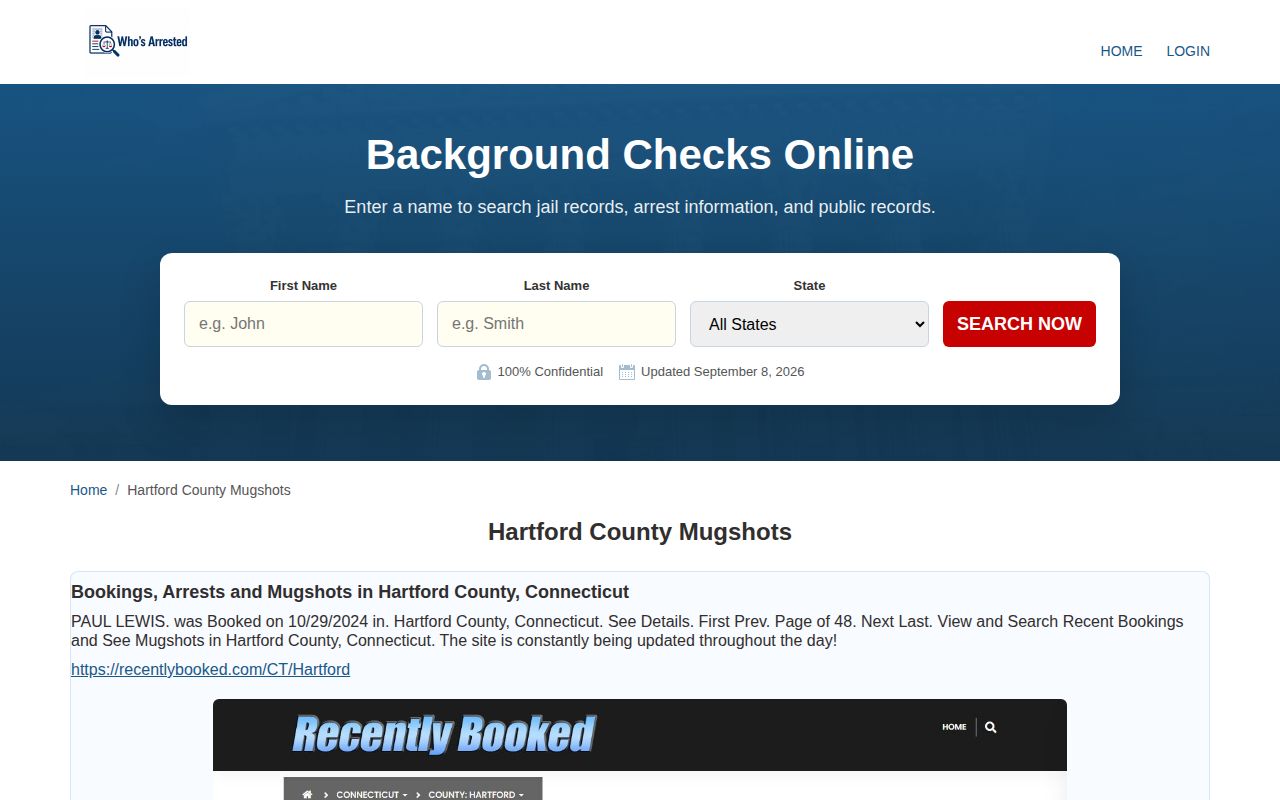
The image above shows an unofficial third-party site rather than a jail roster or any custody listing.
Erasure and Arrest Photo Removal
Start with the case itself. Chapter 961a addresses erasure after outcomes like dismissal, not guilty findings, and qualifying nolle periods. Clean Slate covers certain older convictions once sentences end and waiting periods pass, though exclusions apply. Some matters need a petition. An arrest log alone cannot establish eligibility. The Clean Slate eligibility page explains the seven-year and ten-year categories.
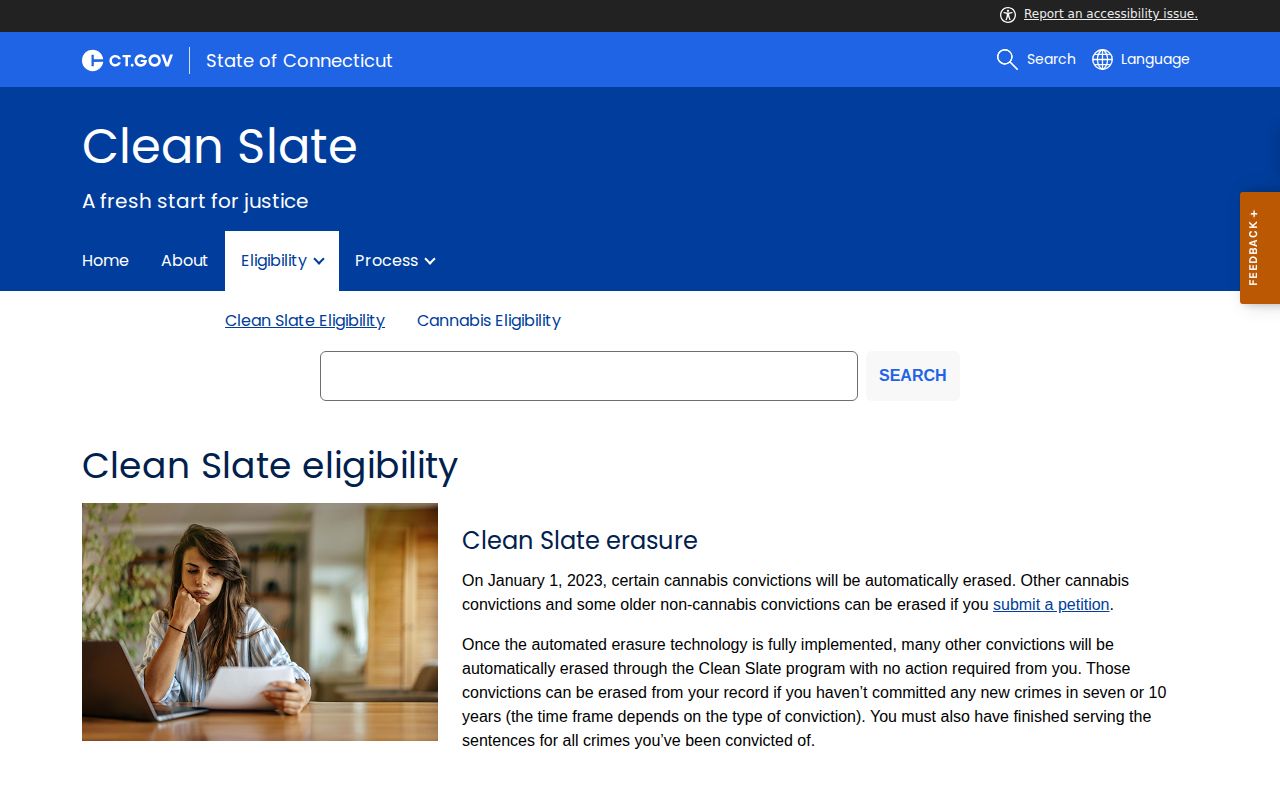
Begin with the state source before asking a clerk or attorney about a docket. Correction, erasure, and third-party removal are three separate things. A police correction cannot delete a DOC or aggregator copy. The identified aggregators offer no verified Hartford-local free opt-out. Use only a plainly published privacy route. Avoid any paid removal service that claims control over courts, agencies, or caches. Search delisting may hide a result without changing its source. No Connecticut anti-pay-to-remove statute is on the books. No operator can promise removal. FOI law, erasure law, court orders, and retention rules govern a more nuanced landscape.
Hartford Arrest Warrants and Wanted Notices
Hartford County has no county sheriff. That means no county sheriff most-wanted list either. Municipal police may publish selected requests for help. State agencies maintain their own wanted or fugitive material. None of it forms a county gallery.
The OPM warrant page publishes monthly municipal counts and links to a public violation-of-probation search. Counts may cover failure-to-appear and violation-of-probation categories. They are delayed statistics, not a live person list. Detailed PRAWN inquiry stays with authorized agencies.
Think a warrant exists? Contact counsel, the issuing clerk, or the responsible agency. Never approach someone based on a wanted notice. Give tips to the named agency, and call 911 for emergencies.
Arrest Logs Are Not Crime Statistics
Arrest logs and crime statistics look similar but answer different questions. Hartford Police publishes both. The log names people arrested and covers whatever window the agency reports. The statistics report counts incidents using its own rules and definitions. Neither one fills the other's gaps. So a spike or dip in log entries is not a crime trend. It cannot stand on its own. You have to weigh report windows first. Enforcement practice, summonses, and corrections matter too. So does how each dataset was defined.
Local news adds another layer, and it is selective. NBC Connecticut, WFSB, and CT Insider might cover an arrest. It could be tied to a warrant, a filing, or a major event. That gives context. It does not give a complete booking feed, and a mugshot is never promised. A story can run days after the police entry. It might skip routine cases or use a scene photo. Keep the publication date separate from the actual date of arrest.
Where Older Arrest Records Go
A Hartford arrest posting can disappear. That does not guarantee destruction. Police can keep an arrest sheet. DOC may hold an institutional file, and the court keeps its docket. Municipal Schedule M7 lists arrest and booking sheets among case-investigation records. Retention varies by series and lawful disposition. For old names, the State Archives databases hold historical Hartford court and Wethersfield Prison indexes.
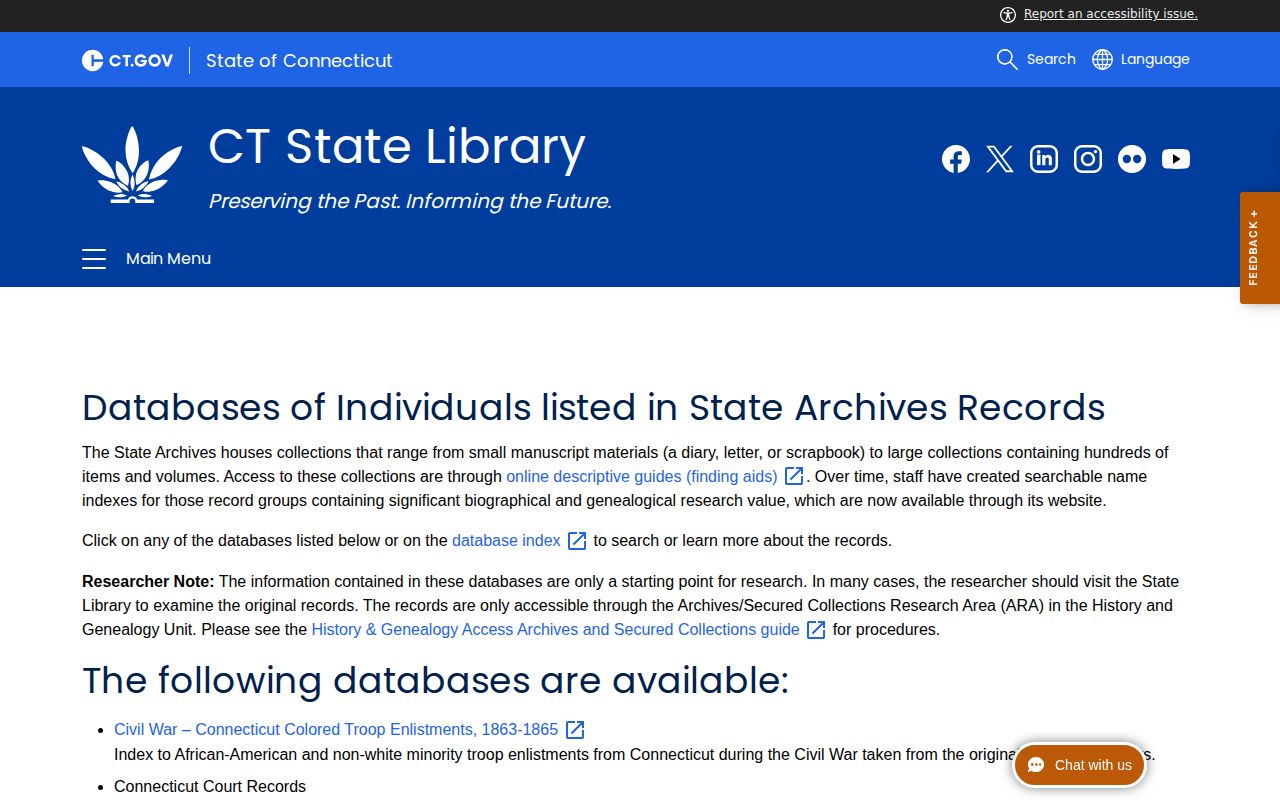
These collections serve history, not current booking or mugshot lookup. For modern material, start with police or DOC. Ask which schedule controls the item. Ask whether it was transferred, erased, sealed, corrected, or destroyed. Publication is not preservation. Keep the source URL, agency, report window, and access date, and skip republishing identities or faces.
Booked, Released, or Sentenced
Each system tracks a different stage. A police log covers the arrest itself, even after release. The DOC locator covers current state pretrial or sentenced custody. A court docket follows prosecution. VINE handles registered alerts. BOP covers federal custody, and ICE runs its own detainee locator. Neither appears in a DOC search. Those boundaries matter most when one person shows up in several systems at different times.
- Booking
- Administrative processing after arrest, including identity and charge data.
- Arraignment
- The first court appearance on the charge.
- Bond
- Terms governing release while the case proceeds.
- Disposition
- The court’s later outcome, such as dismissal, acquittal, or conviction.
- Erasure
- Legal treatment limiting qualifying records after specified events.
A person just arrested in Hartford County may sit in a municipal report. Yet that same person may go missing from DOC, which keeps its own list. Someone awaiting trial can appear in DOC custody anyway. A released person may drop off the live locator. The police record and court docket remain. A sentenced person can move between DOC facilities, and a detainer may affect release too. A blank DOC result can mean release, transfer, timing, spelling, or an excluded system. It never proves that no arrest occurred. Federal locators prove neither a Connecticut arrest nor a routine local booking photo. BOP concerns federal incarceration. ICE concerns immigration detention. Neither belongs merged into a Hartford County arrest list.
Recent Arrests by Hartford County City
Hartford Recent Arrests draws on the daily police report and the city Records Division. New Britain Recent Arrests centers on the weekly blotter and Records Bureau. West Hartford Recent Arrests relies on selected releases plus a records fallback. No full daily log is published there. Arrests from all three cities can end up at Hartford Correctional Center. The center serves their listed courts. Release, bond, transport, and classification each matter. Any one of them can produce a different outcome. So search the city first. Check DOC for current custody, and the court for disposition.
Note: These city sources do not provide complete arrest coverage for every Hartford County municipality.